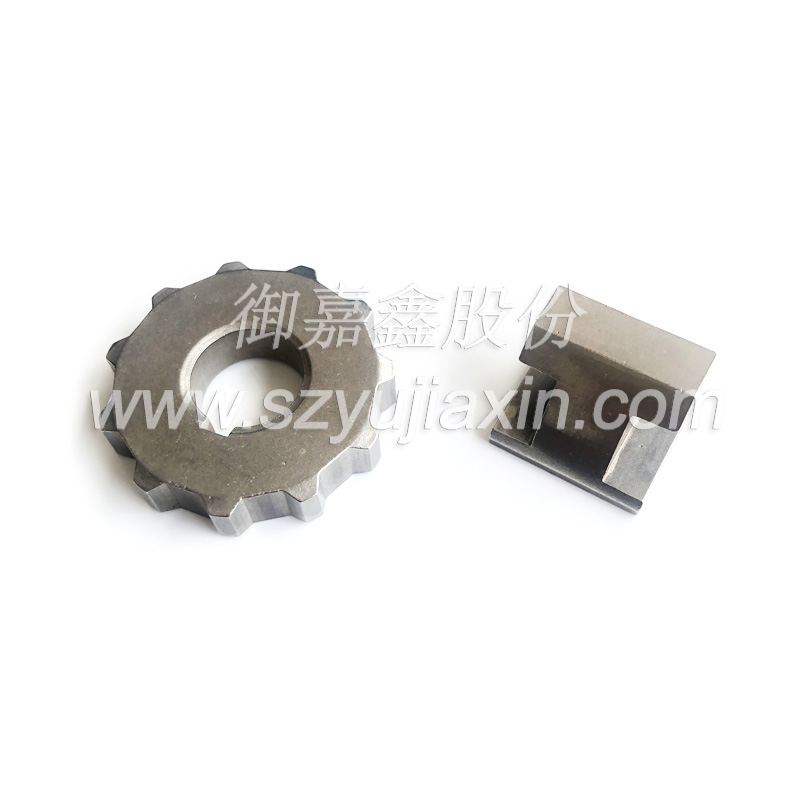
Steel components can adopt powder metallurgy processes. Stainless steel molten water is ejected from a nozzle, atomized by high-pressure water, and then condenses into stainless steel powder. After dehydration, drying, grading, and annealing, the spray stainless steel powder has a loose density of 2.5~3.2g/cm3. It is pressed into shape under a pressure of 550-830 MPa. The pressed billets are sintered in a hydrogen or decomposed ammonia atmosphere at a dew point of -45~-50℃. Alternatively, vacuum sintering at 1120~1150℃ can be used. When excellent mechanical properties and corrosion resistance are required, high-temperature sintering at 1315℃ should be adopted.
Steel can also adopt powder metallurgy processes. High-pressure nitrogen is used to atomize stainless steel water, resulting in spherical powder particles with a porosity of approximately 4.8g/cm3 and an oxygen content in the powder of less than 100×10. This utility model can also employ a rotating electrode milling method to process stainless steel spherical powder with an oxygen content of 40~70×10. These stainless steel powders are loaded into a jacket, vacuum-sealed, and subjected to a cold hydrostatic pressure test at 5kPa and a hot hydrostatic pressure test at 1050℃ and 2kPa. Cold-pressed billets can also be hot-extruded into dense rods or tubes at 1200℃.
I. Anticorrosive Materials for Stainless Steel Powder Metallurgy
Corrosion resistance refers to the ability of stainless steel to resist corrosion by various media. Corrosion prevention includes protection against rust, acids, alkalis, salts, and other corrosive media, as well as resistance to oxidation, sulfidation, chlorination, and high-temperature fluorination. When selecting powder metallurgy stainless steel, attention should not only be paid to its general corrosion resistance but also to local corrosion under specific usage conditions.
II. Research on Mechanical Properties of Metal Powder Metallurgy
The mechanical properties of stainless steel are related to powder characteristics, sintering density, and sintering parameters. For instance, dense stainless steel (6.2-3.6g/cm3) is typically sintered at temperatures ranging from 415-825 MPa in ammonia, hydrogen, or vacuum conditions at 1120-1150℃. Sintering at 1260-1315℃ can achieve good elongation, impact toughness, and corrosion resistance.
III. Machining Properties of Powder Metallurgy Stainless Steel
Sintered stainless steel exhibits similar machining properties to forged stainless steel. Higher sintering temperatures and the use of hydrogen or vacuum conditions can enhance cutting precision. However, under nitrogen-containing conditions, the higher the hardness, the poorer the machining properties become. The inclusion of manganese sulfide in 304L stainless steel can improve its machinability.
 info@szyujiaxin.com
  中文
中文 English
 日本語(yǔ)
 Deutsch
 Русский
 SHENZHEN YUJIAXIN TECH CO.,LTD.